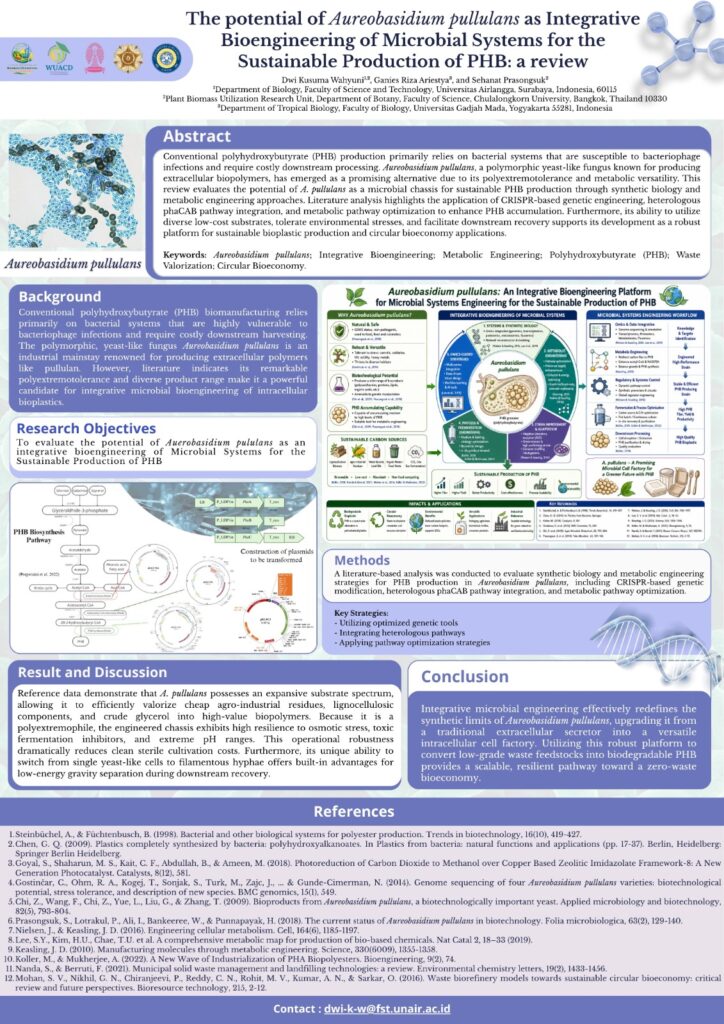
Dwi Kusuma Wahyuni, S. Si., M. Si., Ph.D, Researchers from the Department of Biology, Faculty of Science and Technology, Universitas Airlangga (UNAIR), showcased their latest scientific review through a poster presentation entitled “The Potential of Aureobasidium pullulans as Integrative Bioengineering of Microbial Systems for the Sustainable Production of PHB: A Review.” The work was collaboratively conducted by Dwi Kusuma Wahyuni, Ganies Riza Ariestya, and Sehanat Prasongsuk, representing Universitas Airlangga, Chulalongkorn University (Thailand), and Universitas Gadjah Mada.
The poster highlights the remarkable potential of Aureobasidium pullulans, a polymorphic yeast-like fungus, as a next-generation microbial platform for the sustainable production of polyhydroxybutyrate (PHB)—a biodegradable bioplastic that offers an environmentally friendly alternative to conventional petroleum-based plastics.
Unlike traditional bacterial systems used for PHB production, which are often vulnerable to bacteriophage infections and require costly downstream processing, A. pullulans demonstrates exceptional physiological resilience, metabolic versatility, and the ability to utilize a wide range of low-cost substrates, including agricultural and industrial waste. These unique characteristics position the microorganism as a promising candidate for industrial-scale biomanufacturing.
The review also explores advanced synthetic biology and metabolic engineering strategies, including CRISPR-based genome editing, heterologous phaCAB pathway integration, and metabolic pathway optimization, to further enhance PHB biosynthesis. These approaches aim to develop a robust microbial cell factory capable of improving productivity while reducing production costs.
Beyond its scientific significance, the study emphasizes the role of A. pullulans in advancing the principles of the circular bioeconomy by converting renewable biomass and waste materials into high-value biodegradable plastics. Such innovations contribute to reducing plastic pollution while supporting sustainable industrial development.
Through this poster presentation, the research team hopes to inspire further interdisciplinary collaboration in microbial biotechnology and bioengineering, paving the way for greener manufacturing processes and accelerating the transition toward a more sustainable future. The study demonstrates that integrating microbial engineering with renewable resources can provide practical solutions to global environmental challenges and strengthen the development of next-generation bio-based industries. #SDG 9 #SDG12 #SDG13